
The hour in the middle, done differently.
Four things happen when a lot lands on your counter: it gets entered, it gets priced, it gets sent, and it gets settled. Here is exactly what CounterMint does at each step — where your switches are, and how the quote reaches a customer who won’t give you an email address.
Photo-assisted intake, one line per item
Entering a mixed coin lot by hand is the slowest part of a buy, and it is where the mistakes live. CounterMint starts from a photograph instead. Photograph the lot as it sits — slabs, flips, a tray of raw silver, a stack of notes — and it separates the pile into individual items, giving each one its own quote line.
Each line arrives pre-filled from the details the photograph actually shows: series, year, mint mark, denomination, metal content and weight, plus the grade and holder transcribed from a certification label where one is visible. Melt value, the premium calculation and your suggested band are worked out alongside it, so the line is ready to review rather than ready to type.
Nothing about this is autonomous. It is decision support — extraction of what is visible, plus arithmetic — and every line waits on a dealer’s approval. CounterMint does not grade, authenticate or appraise, and it will not send a number to a customer that a person hasn’t signed off.
Where the photograph is ambiguous, the line says so and asks you rather than guessing. Correct it once and the correction is what gets priced.
Spot that refreshes — and charts itself
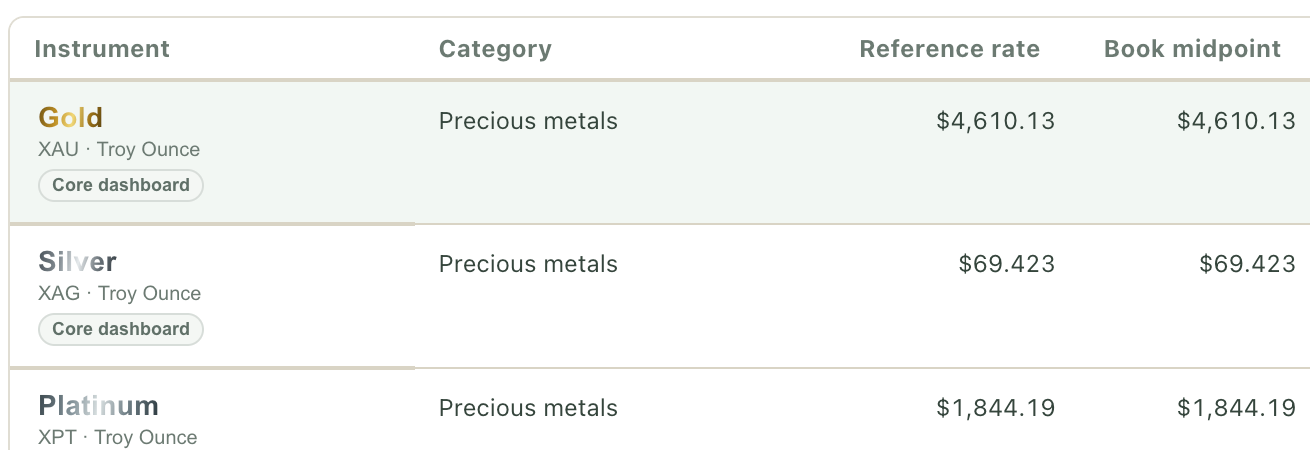
Spot refreshes under every open quote about once a minute as you build it, so the melt floor on line eleven is the same market as line one. Set your buy band off melt by series and grade once, and every line prices itself against the metal in it.
Each metal also charts itself. Tap gold, silver, platinum or palladium and you get an interactive chart of where it has been — hover any point for the price at that moment, switch the window from the last few hours out to the longer trend, and read the direction and the range before you commit a band. Quoting off a market instead of off a number.
Gold, silver, platinum and palladium each track their own market, in your shop’s timezone. When a customer asks whether today is a good day, the answer is on the screen instead of in your memory.
No stale screenshot. No mental math on a moving number. No quote that was accurate an hour ago and quietly isn’t now.
The premium, actually calculated
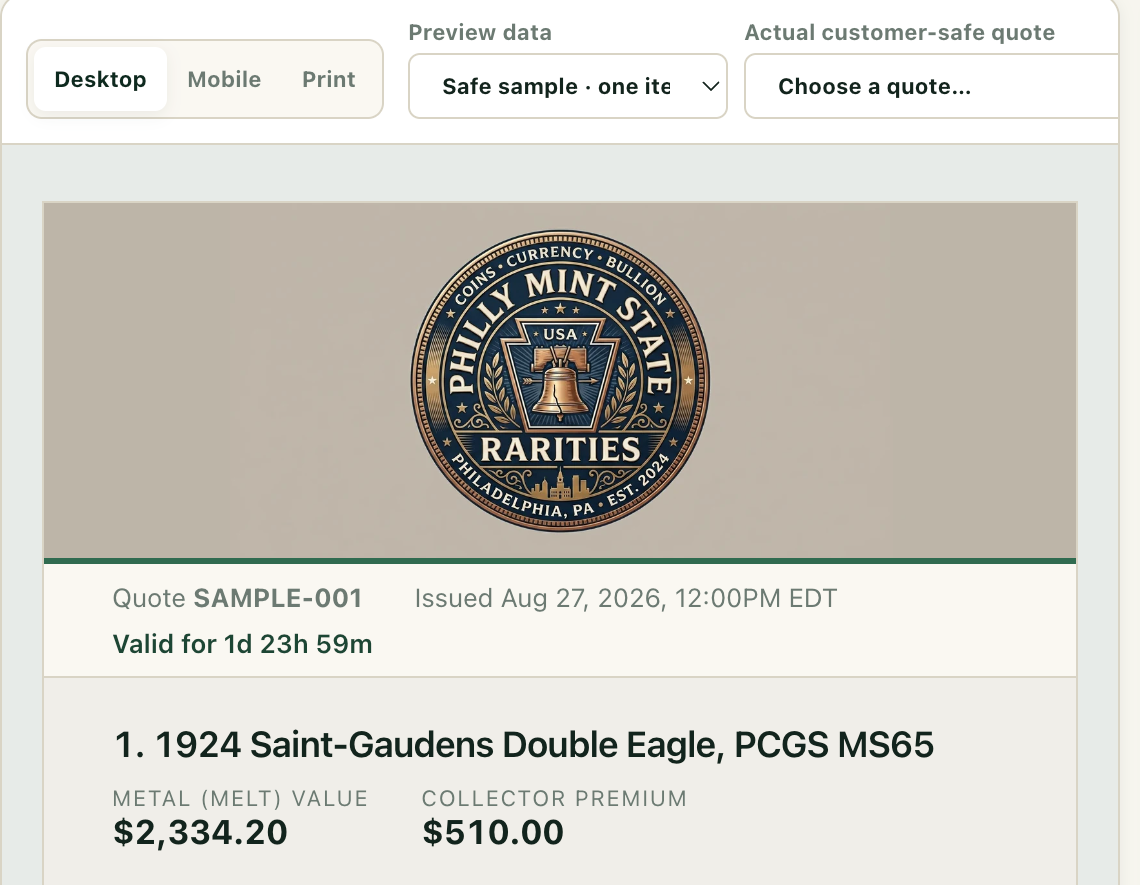
A $2,400 sale in March and a $2,400 sale in August aren’t the same coin — spot moved underneath both. CounterMint normalizes every comp back to the spot on the day it sold and strips the metal out. What’s left is the real numismatic premium, with outliers fenced statistically rather than by eyeball.
Then you set the terms: 100% of melt and 10% of the premium. 20% on prestige pieces. 95% of melt and no premium on generics. With live listings beside the sold evidence, you see the retail side and the margin you’re keeping before you commit.
You see both sides of the market at once: the implied premium sitting in live asking prices — what sellers hope to get — beside the realistic premium that sold comps actually support. The gap between them is the whole conversation, and it’s on the screen instead of in an argument.
So you can show a customer what’s listed today, what a piece like theirs really trades for on average, and the plain fact that you keep a share of that premium to run a shop — while they skip platform fees, seller liability, chargeback and fraud windows, return-shipping risk, and the wait. Cash in hand now, at a number you can both see the arithmetic behind.
The reality check that closes the sale
Every quote can show the customer what the alternative actually costs them: estimated marketplace fees, insured shipping at real published rates, and the net they’d clear after both. Alongside it, what a counter sale gives them that a shipment doesn’t — no chargeback window, no fraud exposure, no return-transit risk, payment today.
It isn’t a pitch, it’s arithmetic. The wording is a template you own and can rewrite in your own voice.
A quote that prices itself
Spot keeps ticking on the customer’s copy too. When it moves, the offer moves with it — inside limits you set per metal: a dead band so noise never touches the number, an upward cap, rounding to your threshold and direction.
The customer sees the number update and sees why, so nobody has to make that phone call.
Nothing gets approved that you didn’t approve
Every automatic behavior has a switch and a boundary. Price moves up after issue? That lands in your review queue by default, not in the customer’s favor by accident.
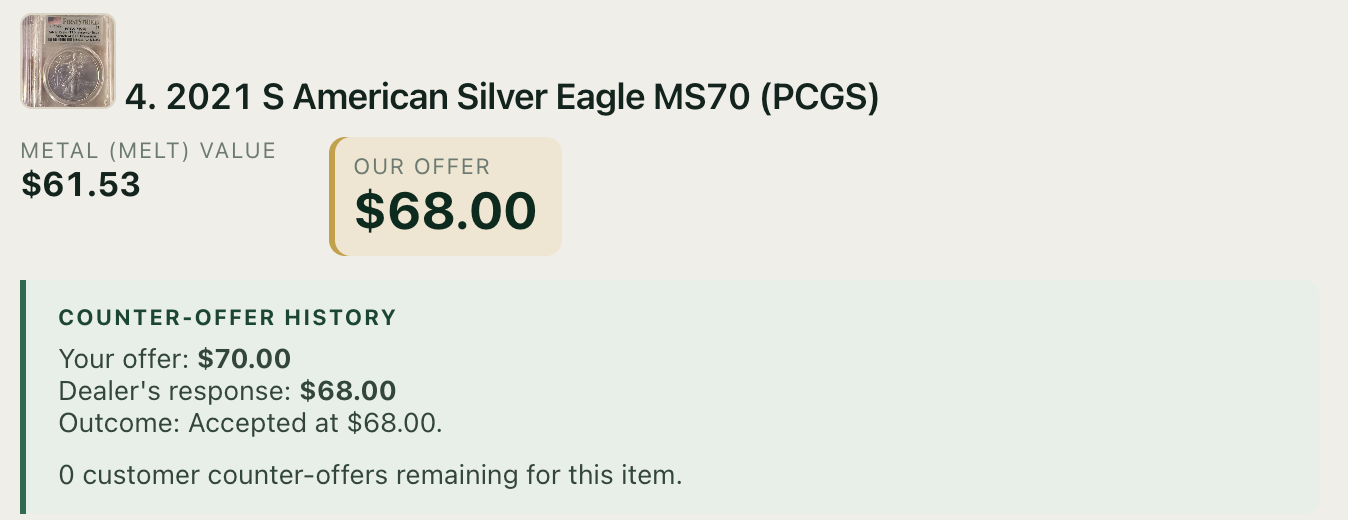
Counter-offers stay off until you turn them on, then capped by count and fenced by band — auto-accept inside a percentage you choose, auto-decline past another, everything between comes to a person. You decide what’s on autopilot and what wakes somebody up.
Two clocks, both yours
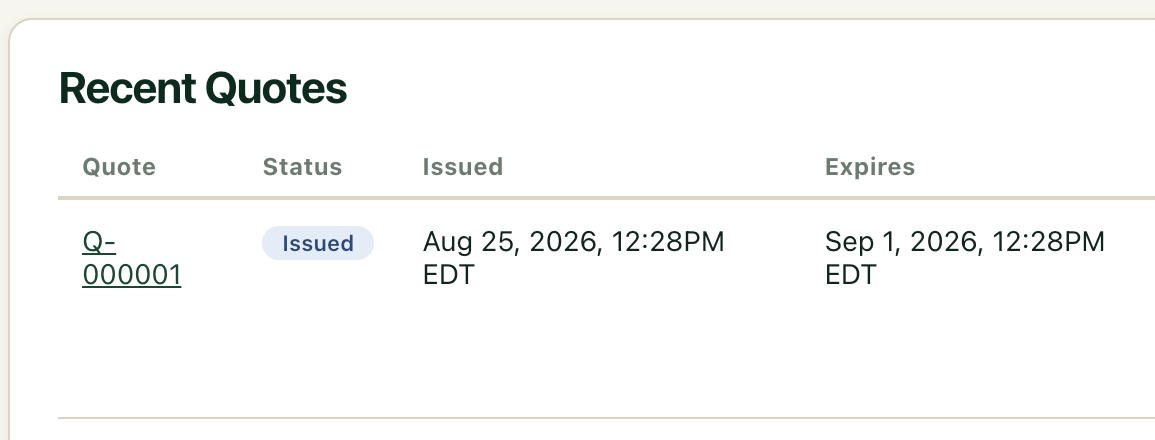
Set how long the quote itself stays valid. Then set separately how long a locked line is honored once both sides agree — a fixed number of hours, or end of business day in your timezone.
That deadline stamps onto the line at the moment of agreement, and reopening the link never restarts it. The customer sees exactly how long they have, in plain language, without anyone having to explain the policy twice.

Every quote, every line, every staffer
Search and filter your entire quote history — by coin, by customer, by date range, by status, by the staff member who priced it. See what happened to each line — accepted, countered, expired, sold — and what the market looked like when the number was set. Who quoted it and who priced it are recorded on the line, not remembered.
Customer records build themselves as you work: who sold you what, at what number, how often they come back. Staff names stay off the customer-facing quote unless you choose to show them.
Three ways it reaches them. None of them is a phone call.
Quotes capture the customer’s contact details as you build them, so the record exists before anyone reaches for a notepad. Two optional consent toggles sit right there: one to deliver this quote, one for future marketing. Both off unless the customer says yes, both stamped with when and by whom.
Then you pick how it travels — inbox, text message, or paper. All three land on the same live quote, so there is no second version of the truth and nothing to reconcile later.
No separate texting service, no mail-merge, no PDF sitting in a downloads folder going out of date.
Publish and it’s gone — branded, itemized, under your shop’s name. Nothing to attach, nothing to paste.
Replies come to the address you set, so the conversation continues in the inbox your staff already watch. Sent with per-shop authentication, so it arrives instead of landing in spam.
One button writes the message on the fly with the live quote link already in it and hands it to the phone in your pocket. You read it, you hit send.
No texting platform to buy, no number to register, and nothing leaves the shop without a person looking at it first.
Some customers won’t hand over an email or a cell number, and that no longer costs you the sale. Print the quote and it carries its own Quote ID and six-digit PIN.
They enter both at the retrieval portal and land in the same live quote everyone else sees.
A printed quote is a key, not a snapshot
Every printed sheet carries a Quote ID and a six-digit PIN. The customer goes to the portal, enters both, and opens the live quote from any phone or library computer — current pricing, the clocks still running, accept or counter right there.
So the walk-in who gives you nothing but a handshake still leaves with something that works four days later. Paper stops being a dead end and becomes your fallback channel.
The portal never reveals whether a Quote ID exists and throttles repeated attempts, so a sheet left on a passenger seat isn’t a way to go fishing through your customers.
quote.countermint.io ↗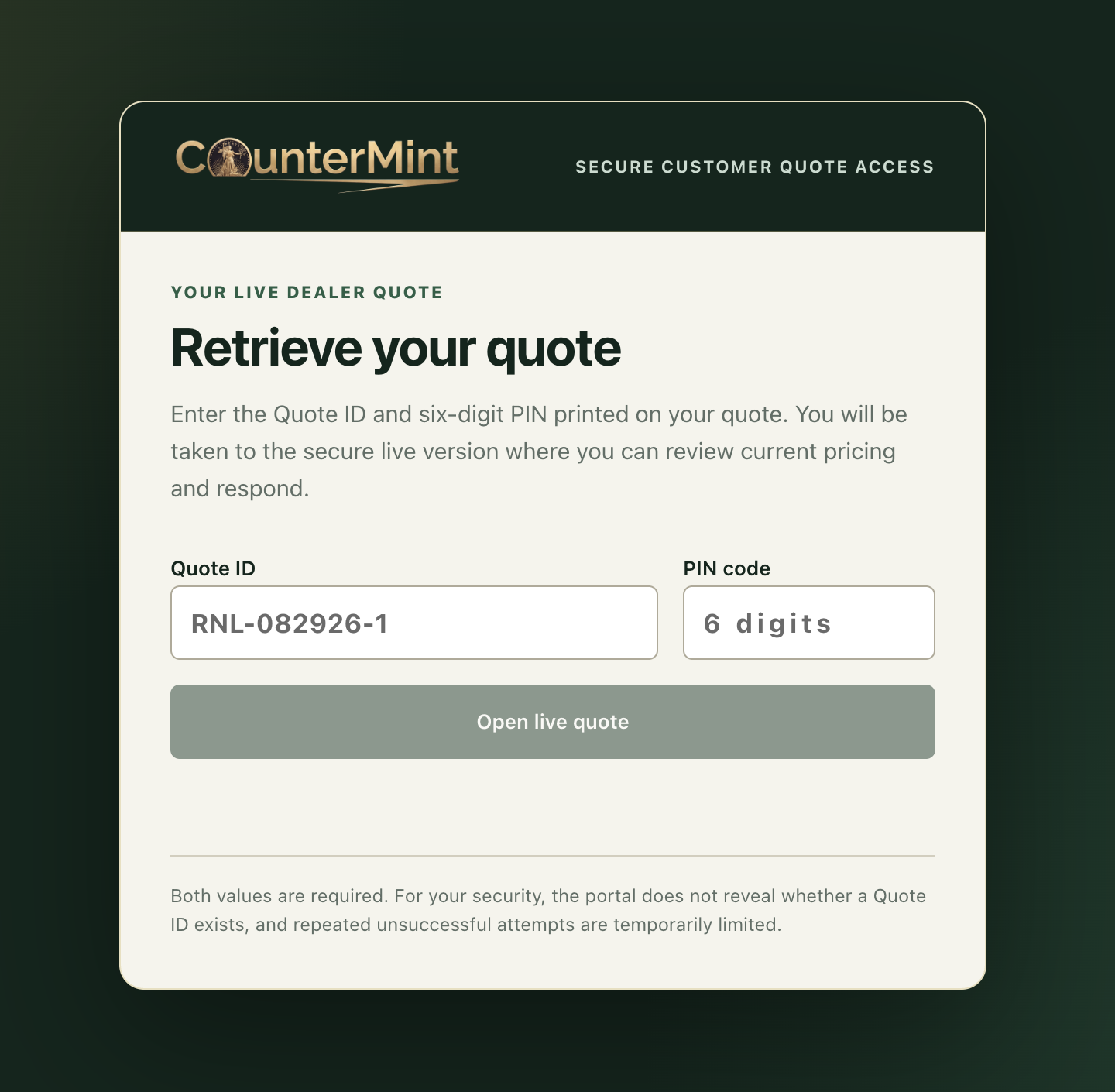
Fifty shops start free, then keep half price for as long as they stay.